• Nominal sizes
- 63 (minimum range 60 mbar);
- 100 (minimum range 6 mbar);
- 150 (minimum range 6 mbar).
• Execution
- A... direct vertical mounting;
- B... surface mounting;
- C... flush mounting;
- D... direct horizontal mounting;
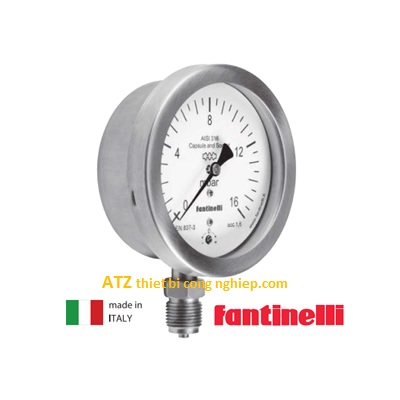
- ...2 stainless steel capsule, brass movement, AISI 316L stainless steel pressure connection (NS 100 and 150);
- ...3 copper-berillium capsule, brass movement, brass pressure connection (NS 63 and 100).
• Casing
- case and ring in AISI 304 stainless steel with bayonet bezel for execution 2 as an alternative for execution 3 NS 100;
- black painted steel case for execution 3.
• Protection degree (according to EN 60529)
- IP 55 for dry execution 2;
- IP 43 for execution 3.
- IP 67 (option V66 and V72) for execution 2;
• Window
- glass for NS 100 and 150;
- plastic snap-fit for NS 63.
• Blow-out device
- blow out plug for NS 100 and 150.
• Pressure connection (according EN 837-3)
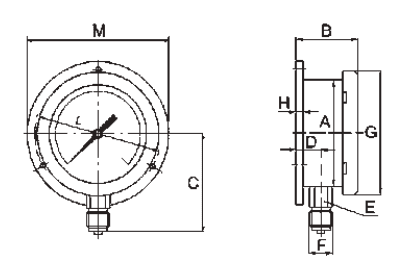
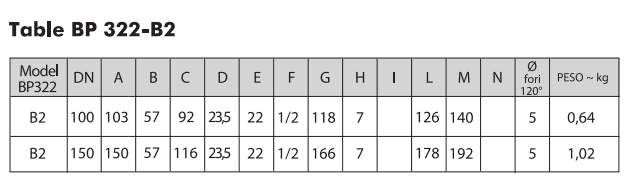
Gas (BSP) or NPT thread as F dimension shown in BP tables:
- brass (execution 3);
- AISI 316L (execution 2).
• Pressure element
- copper-berillium capsule (execution 3);
- stainless steel capsule AISI 316Ti (execution 2).
• Movement
- stainless steel.
• Zero adjustment
- on the dial.
• Ranges (according to EN 837-3)
o Graduation:
- pressure gauges: 0 ÷ 6; 0 ÷ 10; 0 ÷ 16; 0 ÷ 25; 0 ÷ 40; 0 ÷ 60; 0 ÷ 100; 0 ÷ 160; 0 ÷ 250; 0 ÷ 400;
- vacuum gauges: -6 ÷ 0; -10 ÷ 0; -16 ÷ 0; -25 ÷ 0; -40 ÷ 0; -60 ÷ 0; -100 ÷ 0; -160 ÷ 0; -250 ÷ 0; -400 ÷ 0;
- compound gauges: on request. (divisions as per table C1 at page P04)
- other graduations not normalized.
o Unit of pressure:
- mbar, kPa, and psi for single or double range.
o Scale angle:
- 270 °.
• Working pressure (referred to full scale deflection)
- from 1/10 to 2/3.
• Over-pressure (referred to full scale deflection)
- not allowed.
• Pointer
- aluminium not adjustable.
• Dial
- white aluminium with black figures (for dial modifications see available options).
• Accuracy (according to EN 837-3)
- class 1,6 (± 1,6% of full scale deflection).
• Ambient temperature
- -10 ÷+50 °C.
• Thermal drift
- out of optimum ambient temperature values included within +15 ÷ +25 °C, the thermal drift affects the instruments accuracy of 0,5% every 10 °C.
• Operating temperature
- -10 ÷ +60 °C for execution 3;
- -10 ÷ +120 °C for execution 2.